
The relationships, decisions and lessons that built Kitchener Executive Consultants
When Jim Fairfax opened Kitchener Executive Consultants (KEC)’ Kitchener office in October 1976, there wasn’t much to suggest what it would become.
There were no clients waiting. No established candidate network. No reputation to lean on. KEC’s ownership was in Toronto, and Jim had been given a fairly simple mandate for the new Kitchener office: get established, find customers and make placements. He was entering a market where other recruitment firms had relationships going back decades.
So he started knocking on doors.
What followed wasn’t a straight line. Jim left KEC, built another recruitment business, spent more than a decade building his own network, then returned in 1993 as a partner. Later, he and Joan [Jim’s wife] bought out that partnership and continued building KEC’s reach and relationships before eventually passing ownership and leadership to the next generation.
Somewhere along the way, Jim found a way to describe what the work was really about.
A business is a jigsaw puzzle. At any particular moment, something is missing. The job is to understand the puzzle well enough to find the right piece.
That idea followed Jim through changing industries, changing technology, thousands of candidates and client relationships, and nearly five decades with KEC.
Beyond the Placement was created to look at what happens after the search itself, how careers evolve, how businesses change, and how relationships built through one search can continue for years. Ian Fairfax opened the series by sharing his perspective after 18 years of building on KEC’s legacy. For the second conversation, we wanted to go back much further and hear from the person who helped build the Kitchener business from its earliest days.
We sat down with Jim to talk about what those beginnings actually looked like, how KEC grew from a new office with no local clients or candidate network into a business with relationships across Canada, how executive search changed along the way, and what all those years taught him about finding the right piece, and knowing when you’ve actually found it.
Fifty years is a long time to tell as one story.
So rather than looking at KEC’s history as a single timeline, we approached it in five chapters, roughly one for each decade.
Each represents another stage in the life of a business that was never standing still. The people changed. The market changed. Technology changed. The way companies hired changed. KEC itself changed with them, adding another layer to what the business had become.
We started in 1976, when that first layer was still being built.
1976: STARTING WITH A BLANK PAGE

Jim, take us back to October 1976. KEC has fifty years of history now, but what did you actually have when you opened the Kitchener office?
There really wasn’t a plan necessarily.
From the owners’ perspective, it was: get established, find some customers and make placements. There wasn’t necessarily any grander plan. It was seat-of-the-pants.
We were the new kids in town. Kitchener was still a very small big city and there were recruitment firms here that had relationships going back decades.
We had no contacts. We had no inventory of applicants. We had no customers.
So it was perseverance. Call, call, call. Get a chance. Get a meeting. Give us a chance.
It was building blocks.
What made somebody trust the new firm when they already had recruiters they’d been working with for years?
Trust comes after the experience.
They didn’t need to trust us initially. Our proposition was basically: you don’t have to pay until we fill the position, so why not try us?
I understood they’d been dealing with somebody else for 30 years. They were comfortable.
So I’d say, “Why not give us a try?”
But once they gave us an opportunity, then we had to prove ourselves. If they were satisfied with the effort and the result, maybe we got the next assignment.
We built it one step, one search assignment at a time.
Was there a point when you realized KEC wasn’t just the new firm anymore, that the established competition was actually paying attention?
Probably our second year, around 1978.
One of the established firms actually had one of their recruiters arrange a meeting with me, and it turned out she was trying to recruit me to go work for them.
That’s when I thought, Okay. We’re making an impact.
They recognized us.
But there were other things we were learning at the same time about what kind of business we wanted to be.
We had clients ask us whether, if one of their employees approached us looking for another job, would we tell them?
Absolutely not!
Everybody has a right to conduct a confidential job search. Most of our applicants were working. They were conducting confidential searches.
So we built a lot of our foundation around that.
We’re going to be honest. We’re going to be straightforward. We’re not going to misrepresent people or inflate credentials.
That became part of how we operated.
THE EARLY RELATIONSHIPS: WHEN ONE SEARCH BECAME SOMETHING BIGGER

Some of the companies from those early years aren’t around anymore, but others are names I’m coming across again today. Since moving south from Sault Ste. Marie, I’ve kept following what’s happening across Northern Ontario, particularly around mining and critical minerals. Sandvik has been one of the names I’ve been watching because of its developments in Sudbury. I know they were also a KEC client in the early years. How did that relationship begin?
We worked with Sandvik when they came to Guelph.
They opened a plant there making food-processing equipment using freezing technology. We started building their staff before they even turned the lights on, based on a referral from somebody.
There were a lot of companies like that in the early foundation of the business.
Some are still around. Some aren’t.
A lot of Kitchener’s traditional industrial base disappeared over time, but the relationships didn’t necessarily disappear with the companies.
People move.
Someone you’ve worked with at Company A goes to Company B. Sooner or later recruitment comes up and they say, “Have you ever tried KEC?”
Then somebody phones us and says, “Our Materials Manager said he worked with you over there. Can you help us?”
I call that organic growth.
Which is interesting fifty years later because that’s still happening. The company changes, the title changes, but the relationship travels with the person.
If you treat them properly.
Candidates become customers. Customers become candidates. People change companies. Titles change.
That’s why you treat everybody properly.
You never know where they’re going to be five years from now.
1981: STARTING OVER

Your own relationship with KEC wasn’t exactly a straight line either. You left in 1981. Can we make that part of the history clear?
The owners in Toronto were going bankrupt.
Accounting was centralized and I was getting collection calls because bills weren’t being paid. I felt my reputation was being affected in the community.
I approached them about buying the business, but their price was way up there. I was 29 years old. I simply didn’t have the money.
So I left.
I started The Careersmiths with one of the guys I’d worked with and we deliberately established ourselves in Cambridge to create a degree of separation from Kitchener Executive Consultants.
You had built relationships through KEC, though. What happened to those when you left?
I had to contact those customers and say, “I’m not there anymore, and I’d like to continue doing business with you.”
And they quite reasonably said, “How do I know it was you? How do I know it wasn’t KEC?”
So some of them tested us.
They’d say, “I’ll give you the Controller assignment, and I’m going to give it to KEC too. Let’s see how good you really are.”
We didn’t have the applicant files. Those belonged to the previous business.
So just like 1976, we were starting again from a whiteboard. Base zero.
Except this time, we knew what we were doing.
We knew the market. We knew the companies. We knew how to connect the dots.
That made the second start much easier.
And eventually you came back.
Yes.
A friend of mine who had run the London branch eventually had the opportunity to buy KEC, and I came back as a partner in 1993.
Joan and I subsequently bought him out.
So I left KEC, competed against it for twelve years, and then came back to rebuild it.
THE 1990S: THE RÉSUMÉ STOPPED BEING ENOUGH
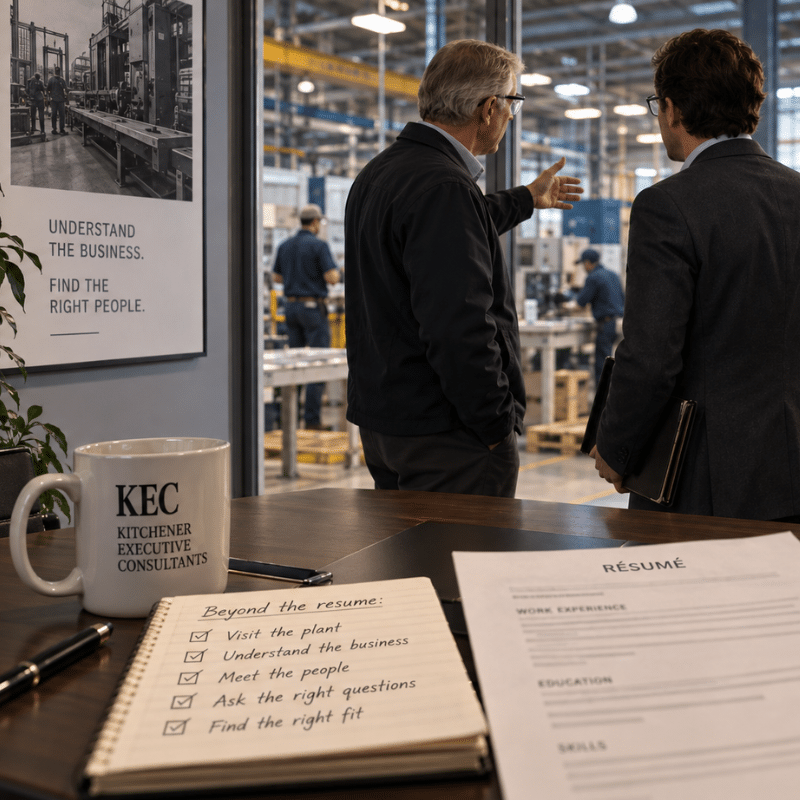
By the time you came back in 1993, was the work itself different from the recruitment business you’d entered in the 1970s?
Absolutely.
Résumés in the old days were basically data sheets. They weren’t about accomplishments. They weren’t statements about change management or making a difference.
But businesses had changed.
By the 1990s, we were talking about management style. We were talking about corporate culture. Companies wanted leaders and change managers. They wanted evidence of accomplishments, not simply somebody who had held the right title.
So our interviewing became much more fact-finding.
Our reference checking changed too.
Instead of simply asking standard yes-or-no questions, we started reference checking around the actual issues at hand.
The client needs this. Has he done it? Has she done it?
That’s what matters.
I used to describe customers as jigsaw puzzles.
Today, they have a missing piece. Our job is to find the missing piece.
And to find it, you have to understand considerably more than what’s written in the job description.
Exactly.
That’s why I’ve always believed you have to get out and see customers.
Go to the plant. See what they make. See how people interact.
See whether the President walks through the plant and knows everybody’s name or whether he’s sitting upstairs behind a closed door.
Those things tell you something about the organization.
Every assignment teaches you more about that company. Every visit teaches you more. Every candidate who interviews there teaches you something. Every person you place gives you another reference point.
Over time, you’re not simply working from a job description.
You understand the organization. You understand the personalities. You understand who succeeds there and who doesn’t.
That’s knowledge.
And on the candidate side, you’re also learning enough about the work itself to test what you’re hearing rather than simply accepting a polished résumé.
Yes.
You’re curious. You ask questions. You visit the customer. You understand what they do.
You don’t personally have to be an engineer to recruit an engineer. But you need to understand enough to know what the client needs, ask the right questions and recognize whether the candidate has actually done it.
The résumé is the starting point.
Then we need to understand what the person actually did. What was their responsibility? What did they accomplish? What was theirs versus the team’s accomplishment? Why did they leave?
And how does all of that relate to what this customer actually needs?
That’s where interviewing comes in. That’s where reference checking comes in. And that’s where experience comes in.
THE 2000S: TAKING THE SEARCH WHEREVER THE CLIENT GOES

By the 2000s, KEC was also beginning to operate much farther beyond Southwestern Ontario. What changed?
Joining NPA Worldwide was a big part of that.
One of the people working in Hamilton, Karen Clark, introduced me to it. By that time the offices were separately owned, and when she explained NPA to me, I immediately thought: Now I’m seeing scale again.
It opened opportunities that weren’t available to us before.
You could be doing a lot of work with a company here and then they’d say, “We’re opening a plant in Charlotte, North Carolina. Can you help us?”
Now I could say yes.
One client asked whether we could help with their plant in Chicago. We ended up making about 15 placements there over roughly three years.
Through NPA, we subsequently helped a client staff up across Canada, placing Managers and Industrial Engineers as they expanded their locations.
We recruited a General Manager in China for an auto parts manufacturer.
We recruited a General Manager in Italy for a local Canadian corporation when they bought two small businesses there and needed somebody to lead them.
Those opportunities arose because suddenly, when a client asked, “Can you help us somewhere else?” we didn’t have to say no.
Which is still an important part of what NPA gives KEC today. If a Canadian client is looking at a new facility in the U.S., Europe or Asia, we can continue to bring the KEC process and our understanding of that client while also working with people who know the local market.
Exactly.
It’s scale. There’s strength in numbers, and there’s a long-game mentality to it too.
I remember situations where somebody had candidates who could help fill one of our assignments, but they didn’t want to share because they’d have to split the fee.
My attitude was always: I’d rather have half of something than all of nothing.
In one situation, I got three halves and kept the customer happy.
So which game are you playing? The long game or the short game?
2008: BRINGING THE NEXT GENERATION INTO KEC

Ian joined KEC in 2008. After everything you’d experienced building the business, were you excited to have your son come into it, or nervous?
Nervous.
Being the boss’s kid is tough enough for anybody.
And we’d seen examples through our client relationships where second-generation ownership didn’t perform as well as the original ownership.
So we didn’t give Ian any special treatment. I think he’d probably say it was almost sink or swim.
We had a team of experienced Recruiters so Ian had to earn their respect and respect of clients and candidates without it being forced.
And he did.
Was there something about Ian that made you think this kind of work might suit him before he’d proven himself professionally?
Something I’d noticed before he even joined the business was his relationships with his friends.
When they had trouble or problems, they called him.
I found that intriguing.
When you notice that people naturally turn to somebody when they have a problem, that tells you a lot about the person.
But being Jim Fairfax’s son could introduce him to relationships. It couldn’t make those relationships his.
Exactly.
You can’t simply hand somebody your relationships.
They have to build their own credibility. They have to earn their own trust.
You can make the introduction, but you can’t transfer trust like an asset on a balance sheet.
The client has to experience the person.
Ian had to recruit. He had to talk to candidates. He had to talk to clients. He had to make mistakes. He had to develop judgment.
You can’t inherit judgment.
Over time, you see how somebody handles a difficult client. You see how they handle a candidate when the answer is no. You see whether customers start calling them instead of always asking for you.
That’s when the relationship isn’t being borrowed anymore.
It’s theirs.
And did you want Ian to become the same kind of recruiter you were?
No. He should be different.
Different generation. Different personality. Different way of communicating.
The principles can stay the same without the people being the same.
Otherwise you’re not building succession. You’re trying to create a copy. That doesn’t work.
The search has changed. The puzzle hasn’t.
One major change since you started is that many companies now have sophisticated internal recruitment teams. Where does an external search firm fit when the company already has that capability?
You have to respect it.
Companies have invested in internal recruitment. Somebody inside that organization has justified that investment.
So don’t walk in saying, “You couldn’t fill this, so give it to us.”
Ask: What’s the one that’s causing you pain?
That’s probably the one they’re eventually going to give you.
And then understand why it isn’t working.
Maybe the expectations aren’t realistic. Maybe the market doesn’t support what they’re asking for. Maybe the compensation is wrong. Maybe different people inside the organization want different things.
Maybe they’ve interviewed people who technically fit, but something isn’t connecting.
You have to understand why.
That’s the value.
It’s not simply, “Give me the job description and I’ll find you résumés.”
Which brings us back to your jigsaw puzzle. Sometimes the missing piece isn’t obvious from the empty space.
Exactly.
That’s where experience comes in.
BEYOND THE PLACEMENT:
WHAT MAKES A HIRE SUCCESSFUL?

Looking through people KEC has placed over the years, I’ve noticed something else.
Sometimes someone stays with the company for two years or five years and then moves on. But when you follow their career, that placement was clearly a significant growth point. They accomplished something for the company, grew themselves, and then eventually took on another challenge.
Does somebody have to stay for the rest of their career for you to call the placement successful?
No.
Go back to the jigsaw puzzle.
You’re finding the missing piece.
A person doesn’t have to stay somewhere for the rest of their life for the placement to have been successful.
Did they contribute? Did they grow? Did the company benefit? Did they benefit?
People’s careers evolve. Organizations evolve.
I’ll give you a perfect example.
A customer built a brand-new plant in Delhi to supply CAMI when CAMI first came to Canada in Ingersoll.
We had the assignment to staff the plant.
We got the right people in there to get it up and running. They won supplier awards from CAMI. Everything was great.
Then, a couple of years later, the Plant Manager called because he wasn’t happy with some of the people anymore.
The task at hand initially had been to get that plant running. He needed technical expertise to do that.
We reviewed that, sometimes, the people who start something aren’t the right people to later manage and maintain it.
Some of those people just weren’t the managers or leaders the business needed at its next stage.
Because you’d originally hired them to solve a different problem.
Exactly.
Boy, they got those machines running. And that’s okay too.
Businesses need different talents at different stages.
You ask somebody to take a department from A to B, make a transition, improve the business.
Then what? Another challenge.
If they leave with the challenge accomplished, is that really so bad?
FIFTY YEARS LATER
So if the puzzle keeps changing, what would you want KEC to continue bringing to it over the next fifty years?
I would hope it continues to prove value through service and that it can satisfy the most difficult challenges a customer might ever have.
That will always be required.
I don’t see technology replacing what we do. To be sure, it will have impact. It’ll be the latest and greatest and people will need to try it.
But when we were building this business and trying to separate ourselves from the pack, we talked about being honest. We talked about integrity. We talked about not overselling or overpromising.
And I used to say: Let’s remember that we’re dealing with people’s lives.
These people have families and homes and marriages. They have dreams. They have aspirations.
We have to do our part not to let them down.
You have the customer and the applicant.
Treat both with respect.
Don’t force something that isn’t meant to be. The process should close itself.
Beyond the Placement
Jim Fairfax’s story of Kitchener Executive Consultants begins with a 24-year-old recruiter asking established businesses to give a new firm a chance.
Fifty years later, almost everything surrounding that conversation has changed.
Newspaper advertisements became online job boards. Paper résumés became digital profiles. Local candidate files became global networks. Companies built their own talent acquisition teams, and technology made it possible to reach more people, faster, than Jim could have imagined when he started knocking on doors in 1976.
But the question underneath the search remains remarkably similar.
What is missing from this business right now?
Sometimes the missing piece is the person who can build a new plant and get the machines running. Years later, the same organization may need a different piece, someone capable of leading what has already been built. A professional may be exactly right for one chapter of a company’s growth and eventually move on to another challenge of their own.
That doesn’t diminish the placement. It is often the reason the placement mattered.
The jigsaw puzzle changes.
The people change.
The challenge is understanding what fits now, while remembering that the pieces themselves are people, with careers, families, ambitions and lives that continue long after the search is complete.
Fifty years later, that may be one of the clearest explanations of what Beyond the Placement really means.